
Imagine, you are at an event or maybe in a call. And someone asks, “Tell us about yourself.” Your heart starts to beat a little faster while your mind goes completely blank. You might start rambling but halfway through, you feel like you are saying too much or worse, you stop completely.
It’s a common experience for all of us, as if you are under a magnifying glass. You want to sound smart, but you end up feeling like you forgot how to speak. This can happen in meetings, interviews or even in casual conversations.
If you can relate to this, remember that talking about ourselves is really hard and the problem is not in you. Infact, this is very common even more than it might seem.
Talking about yourself feels uncomfortable since we are rarely taught how to do it. We learn our skills. We do our work. But no one really shows us how to explain what we do in a clear and simple way.
This is not a confidence problem rather a clarity problem.
The good news is that clarity can be acquired. And once you master it, talking about yourself becomes a lot easier. This blog will guide you through simple ways to introduce yourself, do interviews and make better first impressions coming across as insincere or rehearsed.
What Does “Pitching Yourself” Actually Mean?
The term “pitch” may seem to be used in the context of a sales representative. However, pitching oneself is only letting the other person know who you are.
Consider it this way – when somebody inquires about the film you viewed the previous night, you wouldn’t show them the entire movie with your commentary but just your impression that’s enough for them to get the whole picture.
Pitching yourself works the same way. You are not trying to impress everyone instead just to be understood.
For example, saying “I work in marketing” says very little. Saying “I help companies explain their products clearly to customers” gives a better picture. Same person, same job, just clearer explanation.
That is what pitching yourself is really about.
Start With Clarity, Not Just Confidence
People often say, “Just be confident.” This is bad advice. If you are confident but you don’t know what to say, you just end up talking about nothing. Clarity is much more important than confidence.
Before you start speaking, answer these questions first:
What I do now?
Who does it help?
What is the result or impact?
You do not need fancy answers for these just honest ones.
How to Introduce Yourself Without Sounding Fake
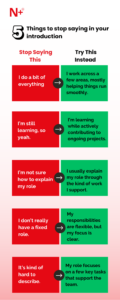
Mostly, introductions are boring since they are either overly long or too vague. People tend to use complicated vocabulary as they suppose it gives them a professional appearance. The listener gets lost very quickly.
A more effective method would be to just be basic and human.
Think of it in a very easy way when it comes to the introductions:
- What do you focus on now
- what you’ve done before
- what you want to do next
You do not need to say everything. Just enough to give context.
Sample introductions
General professional introduction
“I’m Alex. I spend most of my day fixing bugs in computer software. I’ve always loved solving puzzles, so this job fits me pretty well. Eventually, I’d love to build my own apps.”
Networking or casual conversation
“Hi, I’m Sam. Right now, I’m pursuing my degree in graphic design. I’ve spent the last year interning at a local bakery helping them with their posters. I’m really looking forward to working on bigger branding projects after I graduate.”
Internal meeting introduction
“Hi everyone, I am Maya. I’ve just joined the team as a junior writer. Before this, I was writing blogs as a freelancer. I’m truly excited to contribute to the new newsletter and understand how you handle large projects”.
These examples are just starting points that you can easily adjust based on who you are speaking with and the situation you are in.

Want to see these techniques in action?
Watch our masterclass on pitching yourself to see how to turn clarity into career opportunities on-demand: Access the webinar
Answering “Tell Me About Yourself” in Interviews
This is the big one. It is usually the very first question in any interview. It often feels scary because it feels too open a question.
An interviewer only wants to know if you will be able to do the job. They just want a clear picture of who you are in a professional sense. A simple way to answer is to focus on highlights- your current role, relevant experience and where you want to grow.
Here is a quick example:
“I am currently working as a business analyst where my role is to assist teams in interpretation of data and the identification of patterns. I have been collaborating with product and sales teams to enhance the quality of decisions made for the past few years. So, I am ready to develop in a position that will allow me to take on more responsibilities and handle big projects.”
First Impressions Happen Every Day
“First impressions” are not limited to suits and ties.
Within the span of a few seconds people start forming an idea of who you are. Occasionally, the way in which you first introduce yourself determines how people perceive you in the future.
Small choices matter.
How clearly you speak.
How calmly you explain your role.
How comfortable you sound with your own work.
This is not merely a matter of using the right words but of your actual presence. If you enter a meeting and mumble your name, it could lead others to think you are not happy to be there. If you speak clearly and use simple words, you seem more reliable.
Common Mistake made when pitching ourselves
Most mistakes come from nervousness and not lack of skill. However, knowing common traps can help you avoid them.
- Talking too much
- Being too vague and less specific
- Downplaying achievements because we do not want to sound proud
- Sounding unsure by using fillers can weaken the message
These mistakes are normal but can be avoided with little preparation.
Pitching Oneself Is a Skill to build
It isn’t an overnight process to be able to pitch yourself like a pro. However, you achieve a bit of improvement each time you do it.
The best way to do this is through real-life situations. With practice, explaining one’s work in simple terms gets easier.
Platforms like N+ focus on learning that connects directly to everyday work. The idea is not to overload people with information, but to facilitate them to apply those skills in actual areas of use.
That kind of learning supports communication skills naturally over time.
Progress with Clarity
Ultimately, you do not need perfect vocabulary or impressive language. You just need clarity.
Your identity and your work determine the positioning of your words. First impression will eventually come to you as a more natural one.
Mirror or a friend could be your practicing partners for trying out your introduction. Keep it brief and simple. The more you practice it, the more fluent it will sound. You have got this.
FAQs
1. Why do I feel so awkward talking about myself?
Because most of us are never taught how to explain what we do. We learn the work, not the words for it. When someone suddenly asks us to talk about ourselves, our mind scrambles. That awkwardness is normal, not a flaw.
2. Do I need to sound confident in introducing myself?
No. You need to sound clear. Confidence usually comes after you know what to say. When your thoughts are organized, your voice naturally feels calmer.
3.How long should my introduction be?
Keep it under 60 seconds. A few clear lines are enough. If someone wants more details, they will ask. You don’t need to say everything at once.
4. Is it okay to change my introduction depending on the situation?
Absolutely, you’re just being relevant and not fake. The way you introduce yourself in an interview can be different from how you do it in a meeting or casual conversation.
5.Should I mention that I am still learning?
Yes, but don’t stop there. Learning sounds better when paired with action. Talk about what you’re learning and what you’re actively working on.